Friday, September 30, 2016

Implications of the growing Iran-Syria economic relations

Dr. Majid Rafizadeh

A considerable amount of analysis has been dedicated to Iran’s geopolitical, strategic, and military relationships with the Syrian government apparatuses. Nevertheless, the shifting economic nexus between Tehran and Damascus has been subjected less to scholarly work, policy analysis, or media attention.
The changing paradigm in Tehran-Damascus economic ties can have significant long-term implications for Iran’s geopolitical and economic influence in the region.

Iran’s shifting economic paradigm in Syria

Right before the conflict erupted, Iran ratcheted up its investment with considerable amounts of money, resources, skilled forces, and labor in various provinces in Syria.
Large sums of cash and resources were allocated to investments in several sectors such as transportation, infrastructure, and energy, including a joint bank in Damascus, 60 percent of which is owned by the Iranian government, as well as a$10 billion natural gas agreement with Syria and Iraq for the construction of gas pipeline that would start in Iran, run through Syria, Lebanon, and the Mediterranean, and reach several Western countries.
Iranian Supreme Leader Ali Khamenei, the main player alongside Iran’s Revolutionary Guard Corps (IRGC), also supported the allocation of $5.8 billion in aid to Syria by Iran’s Center for Strategic Research (CSR), which concentrates on the Islamic Republic of Iran’s strategies in six different arenas including Foreign Policy Research, Middle East and Persian Gulf research, and International political economy research.
A 17-article agreement was also signed which concentrated on “trade, investment, planning and statistics, industries, air, naval and rail transportation, communication and information technology, health, agriculture, and tourism.” The contracts are mainly between the state organizations while Iran’s main investors are various companies (transportation, food, etc) owned by Iran’s Revolutionary Guard Corps and the Office of the Supreme Leader.
Iran’s economic influence in Syria has exponentially increased contrary to common perceptions. In the long-term, if the Syrian war ends, Iran would be the most dominant player in Syria economically
Dr. Majid Rafizadeh

Iran’s long-term plan

Iran and Syria played almost equal role in economic trade and investments before the conflict, as both held some leverage against the other. But after the uprising, Iran’s economic leverage over Syria increased exponentially causing Syria's debt and dependence on Iran to increase as well.
While some argue that Iran’s economic investment in Syria has decreased, in fact statistics show otherwise. Isolated from the international community and being confined with global sanctions, the Syrian government has become more reliant on Iran. In other words, Iran has become Syria’s economic lifeline. After the conflict, free trade has increased and the trade custom fees have been significantly decreased up to 60 percent, in favor of Tehran.
These agreements are believed to increase Iran and Syria’s annual trade volume to $5 billion. Allaedin Boroujerdi stated that the recent agreements were “a firm response” to the United States and its Western allies “investing billions of dollars to change the political structure of the Syrian government.” Iran has also the dominant role in Syria’s economy since trade between Syria and Turkey and other regional players has significantly shrunk.
Iran’s investments in Syria’s infrastructure, power generation capabilities, and gas market has also increased since then, as part of the reconstruction process. The additional shift is that the investments are not only done with the Assad’s governmental apparatuses, but also with many Shiite militia groups.
Iran’s investments remain mostly in the form of credit lines and loans. Although the war has become costly for Iran, Iran has not abandoned its economic plan in Syria. Tehran’s economic and reconstruction plan in Syria is a long-term one which can pay off very well in the vast market of Damascus if the Syrian war ends. We can make the analogy that Iran’s economic agenda is similar to its plan in Iraq, after US invasion, and partially similar to the US Marshall plan of giving economic support to rebuild Western European economies after the end of World War II.
But Iran is playing a more enduring plan. Some reports indicate that Iran is getting paid back via contracts in Syrian real state by buying Syrian land. This gives Iran considerable amount of power over Syria in the long-term. If the war ends, Iran will be single most important player in Syria economically.

The nuclear deal has definitely made Iran’s economy stronger. This in return has increased Iran’s economic influence in Syria, as it has also benefited Assad as well. Larger infrastructure and energy projects will be more likely on the horizon. Almost every year, Iran is signing a new contract with Syria for nearly over a billion dollars of credit line.
Another area of increasing trade- and Khamenei and the IRGC’s priority- is arms trade with Syria in order to strengthen its defense. Syria is a matter of national security for Iran. Without Iran’s financials assistances, Assad would have not survived.

For example, although there are international economic sanctions against Syria, Iran’s crude oil sale to Syria increased to its highest record of 125,000 barrels a day in March 2015. The amount will more likely increase since sanctions were lifted against Iran.
More recently, Syria and Iran signed several agreements to invest in oil, electricity, power, energy, and other industrial sectors. They discussed “means to implement cooperation between the two countries.” Although it is billions of dollars, it is still hard to quantify the exact estimate Iran’s investment in Syria and its trade.
Iran’s trade and investment in Syria was approximately over $9 billion annually before the sanctions were lifted. This amount is expected to increase to $15-20 billion annually. Iran’s non-arms trade with Syria is still one-fifth (nearly $2 billion) of Iran’s trade with Iraq, which is intriguing since Syria is a conflict-affected state.
Iran’s economic influence in Syria has exponentially increased contrary to common perceptions. In the long-term, if the Syrian war ends, Iran would be the most dominant player in Syria economically. This also suggests that due to the above-mentioned date, Iran cannot afford any peace plan that will lead to the removal of the Alawite state from power.

Thursday, September 29, 2016

IRAN: CHILDREN MUST PAY THE PRICE OF DISASTROUS CONDITIONS IN SCHOOLS


INU - On September 29, in an article published by the National Council of Resistance of Iran (NCRI) excerpts from a letter written by a math teacher in Sanandaj, north-west Iran, Mehdi Fathi. The letter, which was first published on social networks, talks about the tragic conditions in the schools across the country.
Here are some of Mehdi Fathi’s remarks: 
“Less than five months after the old and worn walls of a school (in Sistan and Baluchistan Province) collapsed on the head of the devoted teacher ‘Hamid Reza Gangouzehi,’ we learned that once again in Sistan and Baluchistan the worn walls and doors of another school collapsed over a 5-year old school girl ‘Fariba Chardivari’ who with high enthusiasm along with other children of her age went to school to get her books, but while riding (swinging) on the school entrance door in her childhood world experienced the dream of flying … 
“Even the walls of Sistan and Baluchistan schools and most deprived areas in Iran are fed up with so much educational injustice and are no longer able to bear even the weight of the doors and windows, let alone the weight of a few children hanging on the doors and playing swinging game. 
“The heavy iron door, which is already too much for the wall of the old and worn school, becomes heavier and collapses together with the side column on the head of the children, who are playing and dreaming, and the collapsed wall takes the life on one (child) and sends three others to hospital to let us understand that the life of these schools are over and they must be demolished and we must find a solution for these marginalized and deprived areas. 
“Our language falls short and we do not know how and with what language we should talk to the authorities to make them understand the dire and disastrous situation of schools to think on a fundamental solution? What other disaster should occur until the elite come to themselves and take care of these deprive children? 
“Even the school walls are screaming and brutally taking the life of teachers and schoolchildren in order to flip the society and those profit-driven authorities who prefer their own interest over the collective interests of the people, but thousands of accidents like these will not awaken their sleeping conscience… 
“After these accidents how do we expect the students to be happy and spend half of the day in these schools with fear and trembling? And how do we expect the teachers who should have complete peace of mind and be in total mental calmness to educate and train students? How can they focus while the classroom ceiling may collapse on them and their students at any time? 
“… Here is neither Gaza, nor Iraq, nor Syria… There is no war and no explosion nor suicide bombing to cause the death of schoolchildren and teachers. Here is Sistan and Baluchistan, and the walls of schools have undertaken the task of Daesh (ISIS) taking the lives of students and their teachers one after another. And we are still thinking about sophisticated military equipment to defend these people and this country….” 

Mehdi Fathi – Math teacher of district 1 in Sanandaj

Iran: Amnesty International react to “shameful” 16-year-sentence for human rights defender Narges Mohammadi


NCRI - Amnesty International havehighlighted the recent news that the 16-year prison sentence against Iranian human rights defender Narges Mohammadi, who is critically ill, has been upheld by the Iranian regime’s appeal court.
Their Research and Advocacy Director for the Middle East and North Africa, Philip Luther, said: “This verdict is yet another cruel and devastating blow to human rights in Iran, which demonstrates the authorities’ utter contempt for justice. Narges Mohammadi is a prominent advocate of human rights and a prisoner of conscience. She should be lauded for her courage not locked in a prison cell for 16 years.” 
He added that it is “harsh” and “appalling” that this sentence has been given for human rights work that has been carried out peacefully. He said it is clear that the authorities have “laid bare their intent to silence human rights defenders at all costs”. 
Luther said that this sentence is even more shocking because it comes at a time when Iran’s regime is preparing for renewed bilateral dialogue with the EU, and “given that Narges Mohammadi was convicted for her work campaigning against the death penalty and meeting with the former EU High Representative for Foreign Affairs”. He said that this sentencing raises many doubts about Tehran’s commitment to dealing with the EU over human rights issues. 
“Narges Mohammadi’s conviction and sentence must be quashed and the authorities must order her immediate and unconditional release. We urge the EU to make these calls, too, and put the heightened repression of human rights defenders in Iran at the heart of their dialogue.”

The world's fastest animal is in a race for survival in Iran

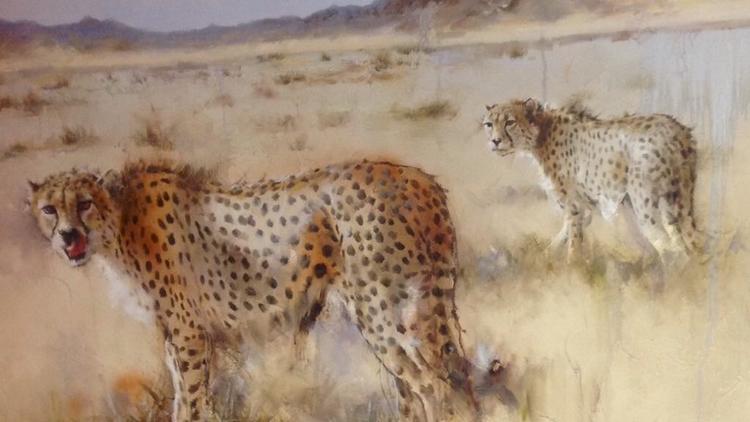
Two Asiatic cheetahs are depicted in this painting by Iranian artist Hossain Irandoust Moghaddam, which hangs in the offices of the national environment agency. (Ramin Mostaghim / For The Times)
By Ramin Mostaghim, Shashank Bengali

The three-acre hilltop park overlooking Iran’s smog-blanketed capital might seem like a nice spot for romance. But the couple has not been in the mood.
Delbar, a 4-year-old female Asiatic cheetah, was brought to the fenced enclosure at Tehran’s Pardisan park by conservation officials who hoped she would mate with Koshki, a 10-year-old male.
After seven months, the coupling has yet to occur, the latest setback in Iran’s effort to save the imperiled big cat whose footprint is carved in Persian literature and history.
Iranian environmental officials report dwindling numbers of the Asiatic cheetah, also known as the Iranian cheetah, a subspecies of the world’s fastest mammal that exists only in the Islamic republic but has been threatened by human encroachment.
Last month, Morteza Eslami, head of the nongovernmental Iranian Cheetah Society, caused alarm when he said that cameras set up in known cheetah habitats had captured images of just two female cats in recent months – a signal that the population “has significantly dropped.”
Shy and more elusive than its African cousin, the Asiatic cheetah is difficult to track and Iranian authorities do not have a reliable estimate of its population. Bahman Jokar, head of the cheetah desk at Iran’s environmental agency, said about 50 cheetahs are believed to remain in Iran’s central deserts – a population so small that to save it requires emergency measures.
“They are in a very dangerous condition,” Jokar said. “We try our best but it is a race against time.”
That is why Iranian officials brought Delbar and Koshki – both of which have lived in captivity since wildlife rangers rescued them from illegal hunters when they were cubs – together at Pardisan park. German experts have been invited to Tehran to advise on how to get the pair to mate.
But experts say female cheetahs typically need to be exposed to multiple males before they are ready. Officials are considering artificial insemination, but environmental authorities also plan to ask parliament to approve a $2.6-million plan to fence off 300 square miles in central Iran for a protected habitat where the surviving cheetahs, male and female, could mate in the wild.
“Unfortunately our government and parliament have other top priorities and saving the Asiatic cheetah is not the top one,” Jokar said.
The big, lithe cat, known for reaching speeds of up to 75 miles per hour, has featured in Iran’s cultural history for at least a millennium. The 10th century poet Ferdowsi, in his epic poem “Shahnameh,” or “Book of Kings,” described how Persian rulers carried cheetahs along on hunting tours to chase prey. One couplet goes, “Three hundred riders moved, after them all cheetah-keepers followed.”
The Asiatic cheetah’s habitat once stretched from the Arabian Peninsula across Iran and east into the Indian subcontinent, but today it exists only Iran. The African cheetah, with a population of about 7,500 spread across nearly a dozen countries, is also described as vulnerable.
As Iran’s population has swelled to 80 million, human settlements have crept closer to cheetah habitats and blocked pathways the cats use to find food and mating partners.
There have been several cases of wild cats being struck by cars along highways, and of conflicts between guard dogs and cheetahs.
In 1994, an Asiatic cheetah and her three cubs came looking for food and water in Bafgh, a town in southeast Iran. Confronted by startled residents, the mother fled and two cubs were killed. The third cub was taken into captivity and named Marita, but it never mated and died in Pardisan park in 2003.
Marita galvanized interest in the fate of the species. The date of his death, Aug. 30, was designated National Cheetah Day. Iran issued commemorative stamps and the national football team has worn patches featuring the animal in international matches.
A nine-year, United Nations-funded project was launched to determine the cheetah population and devise a plan to reverse its decline. But camera traps proved ineffective at tracking the big cat, and experts said the project, which suffered from a high rate of turnover, failed to meet its goals.
Now experts say it is too late to hope that research alone will save the cheetah in Iran.
“In principle, any mammal population is doomed if its population drops to about 50 or so,” making it difficult to ensure that adults produce enough offspring to perpetuate the species, said Mozaffar Sharifi, an ecologist.
Jokar said Iran was in talks with officials at Banff National Park in Canada about designing “ecoducts” – wildlife crossing zones that allow animals to pass through areas of human settlements safely. Iranian environmental officials envision building at least 32 underpasses so that cheetahs can cross beneath highways and avoid road accidents, Jokar said.
Such wildlife crossings are common in Europe. California has plans for an overpass to help mountain lions and other wildife cross the 101 Freeway.
Gary Lewis, head of the United Nations office in Iran, said the Asiatic cheetah did not have to go the way of the Caspian tiger and the Persian lion – two other famed big cats that disappeared from Iran.
“They are gone forever. But it is not too late to save the Asiatic cheetah,” Lewis was quoted as saying on the Iranian environment agency’s website. He said he was inspired by the grassroots efforts of “a very few people in our society who strive – day in and day out – to keep the Asiatic cheetah from harm.”
Among them is Bahman Najafi, a retired park ranger in the desert of Tabas, in central Iran. Along with his wife and son, Najafi has traveled across Iran in a green mobile home with the image of a cheetah painted on the side to raise awareness about the cat.
“For example, in Tabas, if the cheetah were supplied with vegetation and prey such as rabbit and gazelle, and we keep humans away from the area, we can save the Asiatic cheetah from extinction,” said Najafi, a leathery 60-year-old with a gray mustache and wide smile.
“If the species does not survive, I will not survive either,” he said. “I am done too.”

Op-Ed Why Iran is more dangerous than Islamic State

In front of portraits of supreme leader Ayatollah Ali Khamenei, right, and late revolutionary founder Ayatollah Khomeini, left, a long-range missile system is displayed by Iran's army during a military parade held just outside the city of Tehran on Sept. 21. (Ebrahim Noroozi / Associated Press)
     
BY Moshe Ya'alon

US. political leaders of both parties argue that destroying Islamic State is America’s top priority in the Middle East. In reality, that’s not nearly as important as confronting the challenge posed by Iran. The nuclear deal that went into effect a year ago may have postponed the danger of an Iranian nuclear bomb, but the multifaceted threat of a militaristic, messianic Iran — 80-million strong — is much more menacing to Western interests than the Sunni thugs and murderers of Raqqah and Mosul.
In negotiating the nuclear agreement, the P5+1 group of countries — the United States, Russia, China, Britain, France and Germany — registered several benefits. These include delaying the Iranian military nuclear project for 10 to 15 years, defusing political tensions with Iran, opening new markets there, and gaining Iranian cooperation in the fight against Islamic State. Only one of these — the delay in Iran’s nuclear program— comes at Iran’s expense, since both sides shared a desire to achieve the other objectives.
From Tehran’s perspective, it gained much more than it gave up. In exchange for postponing its military nuclear project, it achieved the lifting of many economic sanctions, an end to its political isolation and the loosening of restrictions on its ballistic missile program.
And out of the P5+1’s exaggerated fear of taking any steps that might give the Iranians an excuse to scuttle the deal, Tehran won a lot more too. This includes wide latitude to advance its influence throughout the region as it no longer fears a U.S.-led “military option.”
The Iranian negotiators were brilliant. They played a weak hand superbly.
The evidence of Iran’s rogue behavior is overwhelming. It is the prime backer of the genocidal Syrian regime, providing President Bashar Assad with funds, weapons and the support of Shiite militias. It supplies weapons, money and training to Hezbollah, using it as a strategic tool to undermine the legitimate role of the Lebanese government. In Yemen, Iran fans conflict by sending arms to the Houthi rebels. Elsewhere in the Arabian peninsula, it uses proxies to undermine Bahrain and Saudi Arabia. In Israel’s neighborhood, Iran finances Palestinian Islamic Jihad and certain Hamas elements and provides them with the know-how to produce rockets, drones and other weapons. None of this has abated with the Iran nuclear deal; to the contrary, Iran has grown more aggressive on all fronts.
For an agreement that was supposed to be narrowly limited to finding a peaceful solution to Iran’s military nuclear program, the Iranian negotiators were brilliant. They played a weak hand superbly. And in 14 years, when critical restrictions will be lifted, the world may be in a worse position to prevent Iran’s nuclear project than ever before.
In history and international politics, 14 years is the blink of an eye. And there are many factors — such as the possibility of global events that distract international attention from Iranian violations — that could shrink that time frame significantly.
Concerned nations need to work together now to prevent Iran from exploiting the nuclear deal to redraw the political map of the Middle East in its favor and from capitalizing on the region’s instability to prepare for an eventual nuclear breakout, either before or after the deal’s expiration.
Such steps would include ensuring strict inspection of Iran’s nuclear facilities — and not just by the International Atomic Energy Agency. After all, the vast majority of Iran’s nuclear violations were exposed by western intelligence agencies, not the IAEA. In addition, concerned nations need to pressure Iran on its ballistic missile program and support for terrorism. They must also work to enforce U.N. Security Council resolutions that prohibit Iran’s proliferation of weapons throughout the region. None of these steps, by the way, violates the terms of the nuclear deal.
It is not too late to repair the impression that the West — led by the United States — views Iran as part of the solution to the problems of the Middle East, rather than the chief source of the region’s instability and radicalism. Of course, Iran fights Islamic State; the fact that the world’s leading radical Shiite government fights radical Sunnis should come as no surprise.
Those who believed that the nuclear agreement would lead to a more moderate, open, reformist Iran, at home and abroad, regrettably suffer from wishful thinking. So long as the ayatollah’s regime governs Iran, there is no chance we will see a McDonald’s in Tehran. Instead, we will see more executions, more repression, more tyranny.
This view of Iran is shared across the Middle East by countries that used to be antagonists. While the struggle between Israelis and Palestinians persists, any reference to the conflict between Israel and Sunni Arab states is, for now, obsolete. Today, Arabs and Israelis are in the same boat, facing Iranian-backed threats all around us; in terms of how to address these threats, we are also generally on the same page.
What we lack is leadership from our traditional allies in the West, especially our good friends in America. Should President Obama or his successor shift priorities and lead a campaign to pressure Iran to end its destabilizing policies — applying the same type of pressure that forced Iran to negotiate on its nuclear program — it will find willing partners among both Arabs and Israelis.
Moshe Ya’alon, the Rosenblatt Distinguished Fellow at the Washington Institute, served until May 2016 as Israel’s minister of defense.

U.S. Signed Secret Document to Lift U.N. Sanctions on Iranian Banks

Administration backed measures on the same day Tehran released four American citizens from prison


WASHINGTON—The Obama administration agreed to back the lifting of United Nations sanctions on two Iranian state banks blacklisted for financing Iran’s ballistic-missile program on the same day in January that Tehran released four American citizens from prison, according to U.S. officials and congressional staff briefed on the deliberations.
The U.N. sanctions on the two banks weren’t initially to be lifted until 2023, under a landmark nuclear agreement between Iran and world powers that went into effect on Jan. 16.
The U.N. Security Council’s delisting of the two banks, Bank Sepah and Bank Sepah International, was part of a package of tightly scripted agreements—the others were a controversial prisoner swap and transfer of $1.7 billion in cash to Iran—that were finalized between the U.S. and Iran on Jan. 17, the day the Americans were freed.
The new details of the delisting have emerged after administration officials briefed lawmakers earlier this month on the U.S. decision.
According to senior U.S. officials, a senior State Department official,Brett McGurk, and a representative of the Iranian government signed three documents in Geneva on the morning of Jan. 17.
One document committed the U.S. to dropping criminal charges against 21 Iranian nationals, and Tehran to releasing the Americans imprisoned in Iran.
Another committed the U.S. to immediately transfer $400 million in cash to the Iranian regime and arrange the delivery within weeks of two subsequent cash payments totaling $1.3 billion to settle a decades-old legal dispute over a failed arms deal.
The U.S. agreed in a third document to support the immediate delisting of the two Iranian banks, according to senior U.S. officials. In the hours after the documents were signed at a Swiss hotel, the different elements of the agreement went forward: The Americans were released, Iran took possession of the $400 million in cash, and the U.N. Security Council removed sanctions on Bank Sepah and Bank Sepah International, these officials said.
“Lifting the sanctions on Sepah was part of the package,” said a senior U.S. official briefed on the deliberations. “The timing of all this isn’t coincidental. Everything was linked to some degree.”The Obama administration, under the nuclear deal reached in July 2015, agreed to lift Treasury Department sanctions on Bank Sepah, but U.N. penalties were to remain in place for eight years.A documentary published by Tasnim News Agency, an Iranian media outlet affiliated with the elite Islamic Revolutionary Guard Corps, claimed in February that Iranian government officials had demanded that Sepah be taken off the sanctions list as part of a deal to release the prisoners.
But after the nuclear deal was forged, U.S. officials said, there was a continued dialogue with Iran about the status of the two banks before the deal went into effect in January.
Tehran argued that the banks were critical to the country’s economy and international trade. Bank Sepah is Iran’s oldest bank and one of its three largest in terms of assets. Bank Sepah International, based in London, was key to financing Iran’s international trade before sanctions were imposed.
U.S. officials said there was a desire in Washington to harmonize the U.N. sanctions list with the U.S.’s. And they said Washington believed Iran had earned more sanctions relief because Tehran had been implementing the terms of the nuclear agreement, which called for a major scaling back of its infrastructure and production of nuclear fuel.
“The issue of Bank Sepah has been one of many topics we discussed with Iran in our overall diplomatic discussions,” said a second senior administration official briefed on the deliberations.
Another senior administration official said lifting sanctions on Bank Sepah and its London affiliate was in the spirit of the commitment by the U.S. and other world powers to provide Iran with sanctions relief.
Administration critics and some congressional officials said they believed the move broke the commitments the administration made to Congress about the deal.
The Obama administration had told Congress that under the deal the U.S. would lift sanctions only on companies and individuals tied to Iran’s nuclear development. Sanctions on those involved in missile development were to remain in place, these critics said.
The Obama administration has repeatedly said it is committed to rolling back Iran’s ballistic missile program.
“By agreeing to remove U.N. and EU sanctions eight years early on Iran’s main missile financing bank, the administration effectively greenlighted their nuclear warhead-capable ballistic missile program,” said Mark Dubowitz, a top critic of the Iran nuclear deal at the Foundation for Defense of Democracies, a Washington think tank.
The U.S. Treasury Department sanctioned Bank Sepah, Bank Sepah International and its then-chairman in 2007 for their alleged role in backing Iran’s missile program. The designation didn’t mention what direct role the entities allegedly played in helping Iran’s nuclear program.
At the time, the Treasury said that Bank Sepah and Bank Sepah International had provided financial support to Iranian-state owned companies and organizations developing Iran’s missile program. These included Iran’s Aerospace Industries Organization and the Shahid Hemmat Industries Group.
“Bank Sepah is the financial linchpin of Iran’s missile procurement network and has actively assisted Iran’s pursuit of missiles capable of carrying weapons of mass destruction,” the Treasury said in a January 2007 statement.
Iran has conducted up to 10 ballistic missile tests since the forging of the nuclear agreement in July 2015. The U.N. Security Council has condemned Tehran’s actions but hasn’t moved to impose any new sanctions on the country.In March, the Treasury Department imposed sanctions on two Iranian companies it said were working with Shahid Hemmat Industries.
U.S. officials said the Obama administration closely vetted the activities of all individuals and entities tied to Bank Sepah before supporting the lifting of U.S. and U.N. sanctions.
“We have the ability to quickly reimpose U.S. sanctions if Bank Sepah or any other entity engages in activities that remain sanctionable,” said the second senior U.S. official.
The Obama administration’s decision to send such large amounts of cash to Iran has fueled charges in Congress that the White House paid ransom to Tehran to secure the release of the American prisoners. The White House has repeatedly denied the charge, saying the $1.7 billion settlement saved the U.S. as much as $8 billion that it could have owed Iran if it lost, as was expected, a court proceeding that was taking place in The Hague, Netherlands. The administration has said the cash was used as “leverage” to make sure the American prisoners were released.
The dispute in Washington has only deepened in recent weeks, as senior Pentagon officials, including Secretary of Defense Ash Carter,told Congress in a hearing that they weren’t notified by the White House about the cash transfer. The chairman of the Joints Chief of Staff, Marine Gen. Joe Dunford, said at a hearing last week that he found it “troubling” that the U.S. provided Tehran with so much cash, which he argued could be used for “spreading malign influence.”
Write to Jay Solomon at jay.solomon@wsj.com and Carol E. Lee atcarol.lee@wsj.com

Female Chess Players Are Furious About Having to Wear Hijabs at the World Championship in Iran

U.S. Women’s champion Nazi Paikidze. Photo: ZUMA Press/Alamy
Many of the world’s highest-ranking female chess players are boycotting next year’s world championships in Iran after being told that they’d need to compete wearing hijabs.
FIDE, the international governing body of chess, has been accused of failing to stand up for women’s rights in their selection of a host country, theTelegraph reports. Hijabs have been mandatory for women in Iran since 1979, and those not wearing the garment face arrest, a fine, or public admonishment.
Grandmasters have accused FIDE of disregarding sexual discrimination by selecting a place that would require the competitors to wear hijabs. Meanwhile, FIDE’s Commission for Women’s Chess has urged participants to accept the hijab regulations in respect of “cultural differences.” The U.S. women’s champion, Nazi Paikidze, is among the many players who are furious about the requirement. She told the Telegraph that it’s “absolutely unacceptable” for the organization to host one of the most important women’s tournaments in Iran:
“I understand and respect cultural differences. But, failing to comply can lead to imprisonment and women’s rights are being severely restricted in general. It does not feel safe for women from around the world to play here. I am honored and proud to have qualified to represent the United States in the Women’s World Championship. But, if the situation remains unchanged, I will most certainly not participate in this event.”
Paikidze also tweeted out a screenshot of a recent U.S. travel warning for Iran, in which citizens were warned that they face a risk of detention and arrest in the country.